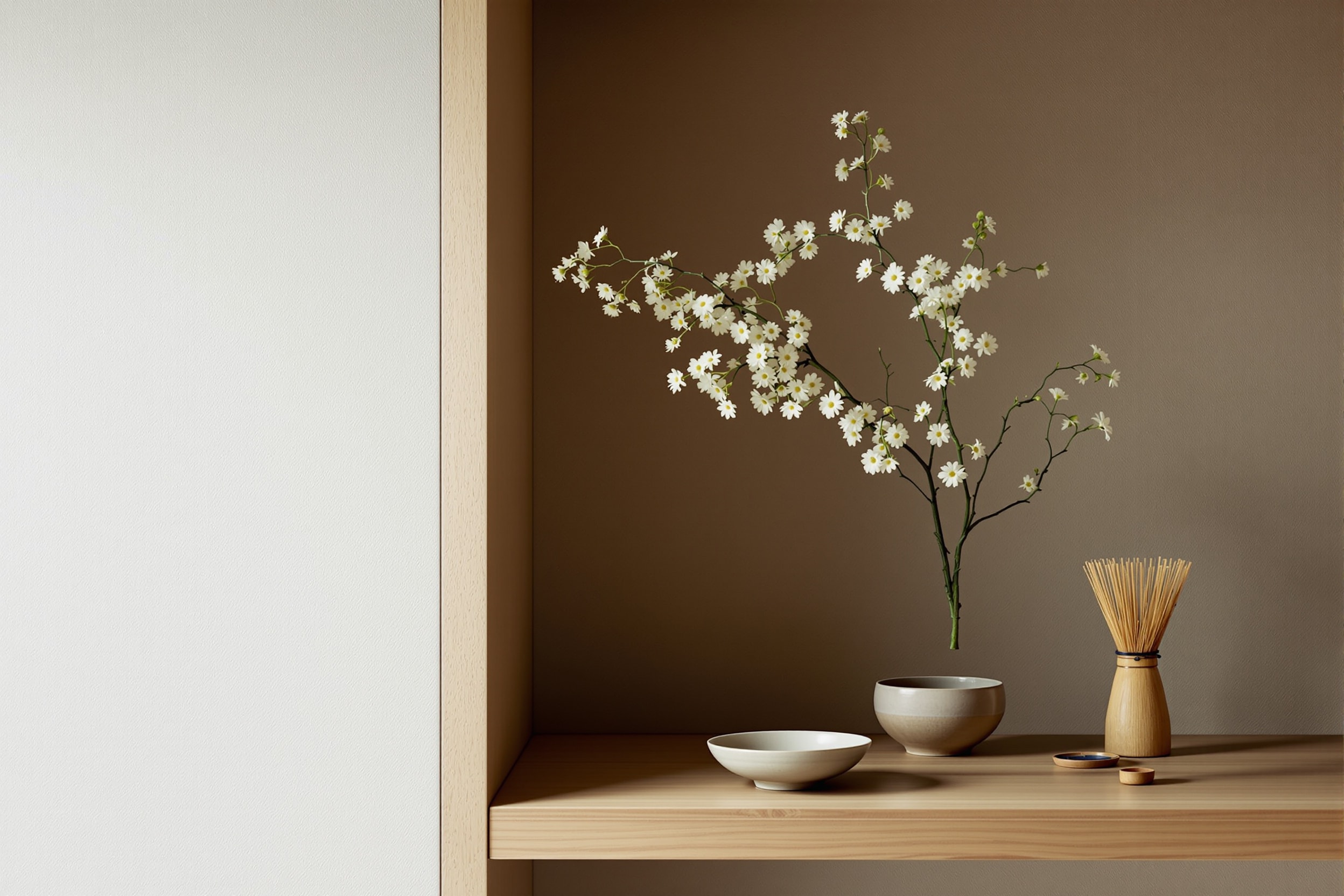
A storyteller's art is inseparable from the culture that surrounds it. The manners, seasons, dress and aesthetics that fill rakugo's classic tales are the same ones expressed in Japan's other traditional arts. To love rakugo is to be drawn, sooner or later, into the wider world of tea, flowers and kimono.
This page offers a gentle introduction to the traditional arts that frame the storyteller's stage.
Chadō — the way of tea
The tea ceremony (chadō or sadō, "the way of tea") is a choreographed practice of preparing and serving powdered green tea. Far more than a drink, it is a discipline of hospitality, attention and impermanence, guided by the ideal of ichigo ichie — "one time, one meeting," the sense that each gathering is unique and unrepeatable.
That same value animates rakugo. Every performance of a familiar story is a one-time event, shaped by this audience on this evening. The tea room's lessons in timing, silence and grace are lessons the storyteller quietly shares.
Kadō — the way of flowers
Ikebana (or kadō, "the way of flowers") is the art of arranging flowers according to principles of line, space and seasonality. Unlike a full Western bouquet, an ikebana arrangement prizes asymmetry, emptiness and a single expressive gesture — often just a few stems poised in deliberate imbalance.
This aesthetic of suggestion, of saying much with little, is deeply Japanese and deeply akin to rakugo's own minimalism. Both arts trust the audience to complete the picture.
Kimono and the seasons
Traditional dress and the calendar are woven through Japanese culture. Kimono are chosen for the season — their colours, motifs and weights shifting with the months — and countless customs mark the turning year, from spring blossom-viewing to summer festivals and autumn moon-gazing.
Rakugo's classic stories are steeped in this seasonal awareness. A tale may hinge on a summer ghost, a New Year's debt or an autumn journey, and knowing the customs enriches every joke. The performing arts and the domestic arts share one calendar.
Furoshiki, fans and everyday craft
The culture also lives in small, everyday objects: the furoshiki wrapping cloth that carries anything if folded cleverly, the folding fan that cools and signals, the daruma doll that embodies perseverance, the seasonal sweets served with tea. These humble things carry centuries of design intelligence.
Understanding them deepens one's enjoyment of rakugo, whose stories are populated by exactly such objects. For structured introductions to these arts, national cultural institutions offer excellent English-language resources.
One aesthetic, many arts
What unites tea, flowers, kimono and storytelling is a shared sensibility rather than any single rulebook. All of them prize suggestion over statement, the beauty of the incomplete, and a heightened awareness of the passing season. All of them treat restraint as a form of generosity toward the audience or guest.
Seen this way, rakugo is not an isolated curiosity but one branch of a single cultural tree. The storyteller who masters timing and understatement is practising, in a comic key, the very qualities the tea master pursues in silence. To wander among these arts is to keep meeting the same values wearing different clothes.
Further reading
For introductions to the traditional arts, see The Japan Foundation, and official cultural resources from Japan's Agency for Cultural Affairs.