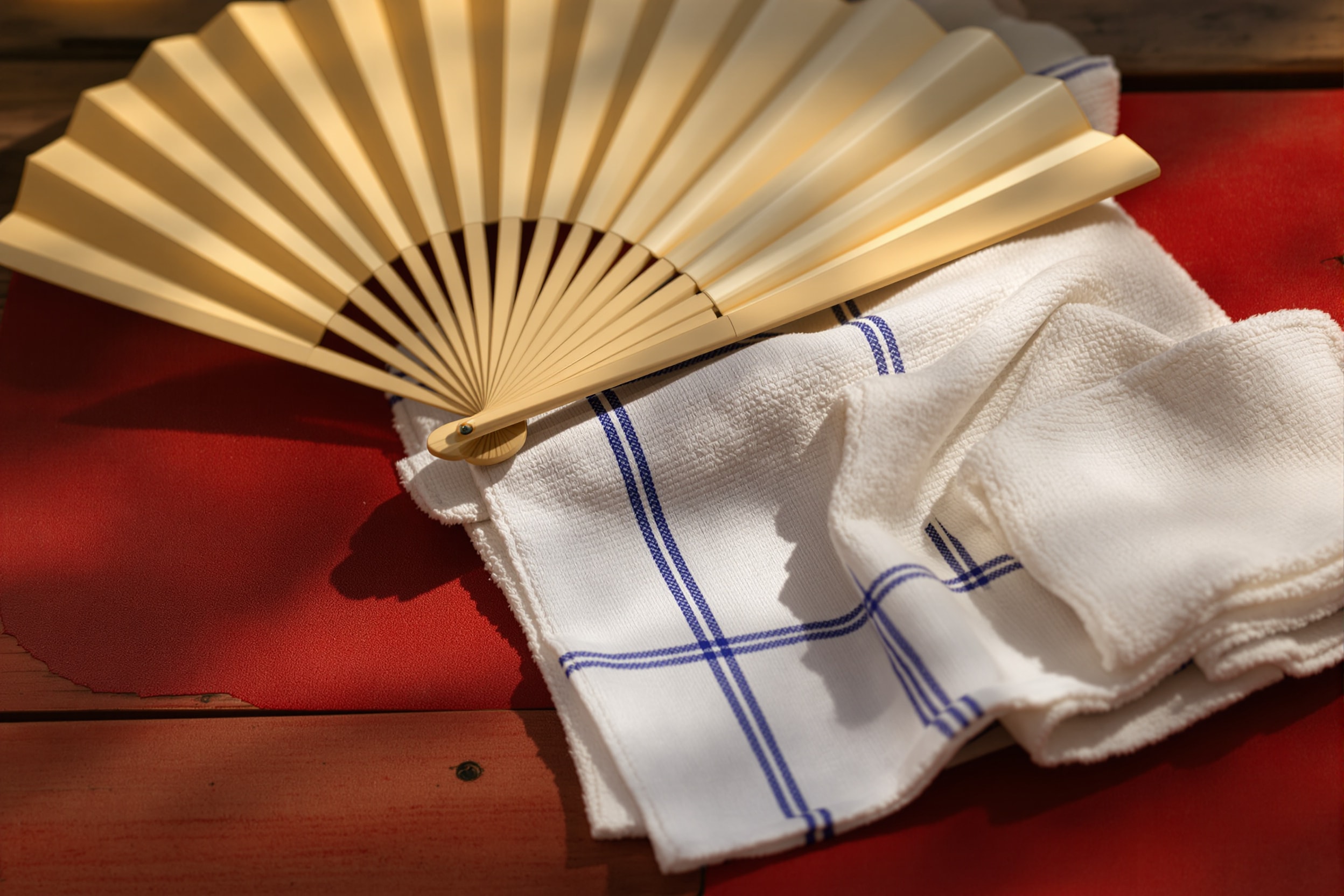
It is theatre stripped to its essentials. There is no set, no costume change and no supporting cast. A storyteller in a plain kimono, armed only with a folding fan and a small hand towel, holds an audience for twenty or thirty minutes through timing, characterisation and the listener's own imagination.
A single performer, many characters
The heart of rakugo is the dialogue between characters, all played by one person. The performer distinguishes them not through costume but through subtle shifts of the head, voice and gaze. Turning slightly to the right to speak, then to the left to answer, a storyteller can stage an entire argument between a blustering landlord and a quick-witted tenant while never leaving the cushion.
This convention — the kamishimo o kiru, or "cutting" between upstage and downstage — lets the audience follow who is speaking with perfect clarity. The mind fills in the rest: the crowded tenement, the sake shop, the moonlit road. Rakugo has been called a theatre of the imagination precisely because so much of the scenery is built inside the listener's head.
Two humble props
A rakugo performer carries just two objects onto the stage. The sensu, a folding paper fan, becomes whatever the story requires — chopsticks lifting noodles, a writing brush, a fishing rod, a sword, an oar, a pipe. The tenugui, a rectangle of cotton cloth, stands in for a letter, a wallet, a book or a towel.
Part of the pleasure for a seasoned audience is watching these transformations. The same fan that was a soup ladle a moment ago becomes a flute, and the switch is sold entirely through mime and rhythm. Great economy of means is itself part of the artistry.
The shape of a story: makura, hondai and ochi
A typical performance has three movements. It opens with the makura ("pillow"), an informal, often improvised warm-up in which the storyteller chats with the audience, tests the room's mood and quietly plants any background knowledge the coming tale will need.
The hondai is the main story itself — a classical piece handed down for generations, or a newer original composition. It closes with the ochi, the punchline that gives the form its name. Some ochi are puns; others are sudden reversals or absurd turns of logic. The best land so cleanly that the whole tale seems to have been built, invisibly, toward that single final beat.
The audience completes the picture
Rakugo may be a solo art, but it is never made by the performer alone. Because scenery and objects are only suggested, listeners supply the room, street or river in their own minds. A clear glance, a measured pause and the angle of an imaginary cup give the audience just enough material to do that work.
This shared imagining also shapes the rhythm of comedy. A storyteller can allow laughter to settle, sharpen a silence or repeat a gesture once the room understands its meaning. The performance therefore remains alive to the people present, even when the tale itself has travelled through generations.
Comedy, but not only comedy
Although rakugo is fundamentally a comic art, its emotional range is wider than the laughter suggests. Within the repertoire sit tender human dramas that move audiences to tears and eerie ghost stories that raise the hairs on the neck. A single performer may draw a belly laugh one moment and a hush the next, all from the same cushion.
This is possible because rakugo trusts its listeners completely. With no scenery to lean on, the art hands the audience the raw materials — a voice, a gesture, a pause — and lets them build the feeling themselves. That collaboration between teller and listener is the deepest pleasure the form offers.
Sitting down, standing out
Rakugo belongs to a family of Japanese seated storytelling and variety arts known collectively as engei, performed in small theatres called yose. It sits alongside cousins such as kōdan (dramatic historical narration) and manzai (fast two-person stand-up), but rakugo is distinguished by its intimacy and its comic, character-driven narration.
Because the form asks so little of the stage and so much of the performer, it travels remarkably well. A cushion, a fan and a willing audience are enough — which is one reason the art has found new life in translation and on stages far from its Edo-period birthplace.
Classical and contemporary
Rakugo divides broadly into two bodies of work. Koten rakugo is the classical repertoire — stories set in the Edo period and handed down, largely unchanged, for generations. Shinsaku rakugo is newly written material, often contemporary in setting and subject, composed by performers working today.
Both share the same architecture of makura, story and ochi, and a skilled performer moves easily between them. Together they show that rakugo is neither purely a heritage art nor purely a modern one, but a living form still adding to its own tradition.
Further reading
See the government-supported culture portal Web Japan.