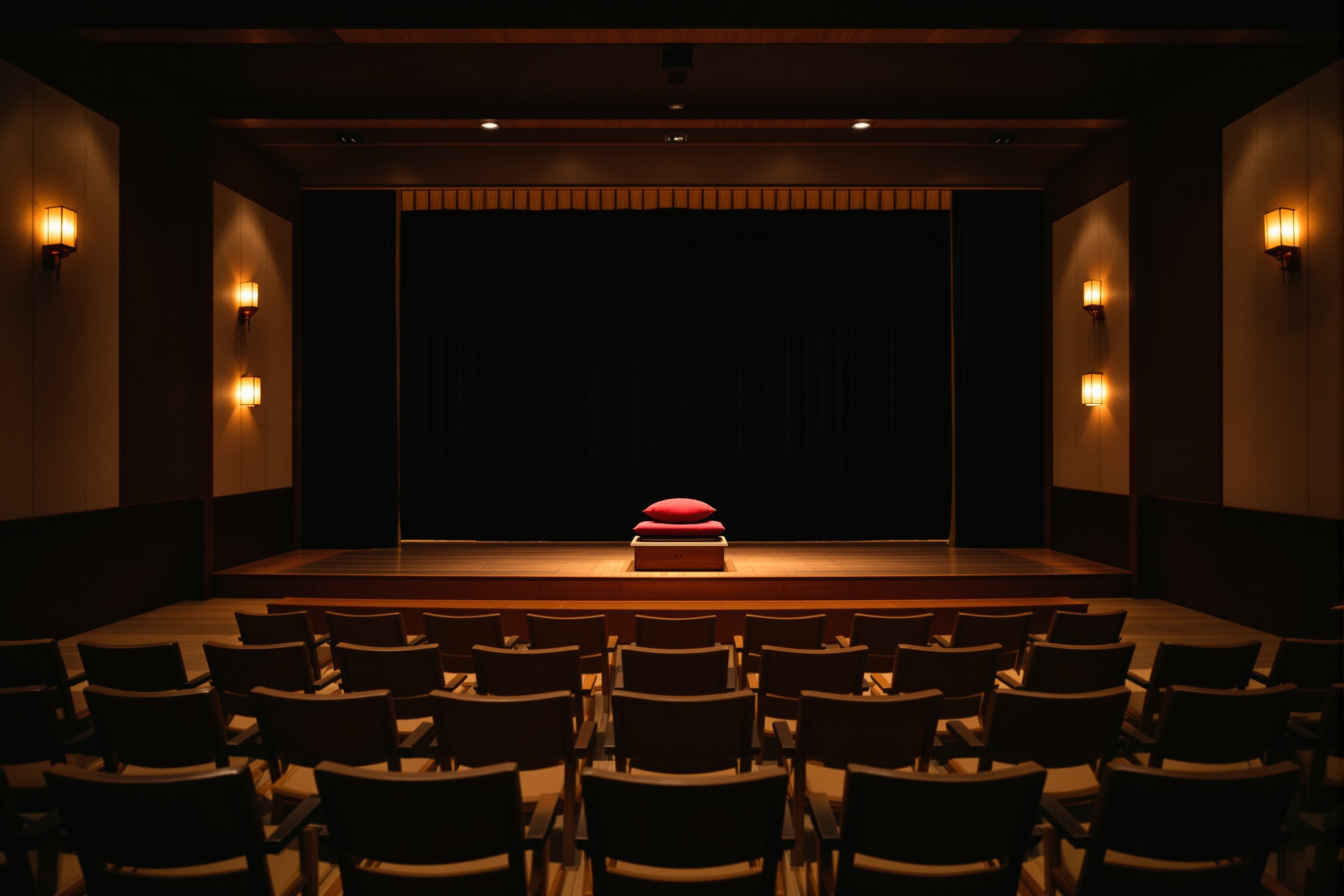
For most of its history, rakugo lived entirely in Japanese. Over the past few decades, however, a growing movement has carried the art into English and other languages — performing the same classic tales, and new ones, for audiences who may never have heard of a yose hall.
English rakugo is not simply translation. It is a craft of adaptation, and it has become one of the liveliest frontiers of the form.Why rakugo travels well
Rakugo's minimalism is its passport. With no set to rebuild and no cast to recruit, a performer can carry the entire art in a cushion and a fan. The stories themselves are deeply human — about greed, love, laziness, cleverness and misunderstanding — and those themes cross borders easily. A tale about a tenant dodging the rent or a gambler outsmarting himself needs little cultural translation to raise a laugh.
The translator's puzzles
The difficulty lies in the details. Many classic ochi are puns that depend on the sound of Japanese words, and a literal translation would simply fall flat. Performers of English rakugo must decide, story by story, whether to find an equivalent English wordplay, to reshape the ending, or to add a light explanation inside the tale itself.
Cultural references pose the same challenge. A joke resting on the geography of old Edo, a seasonal custom or a class distinction may need a quick, graceful gloss so that the humour lands without a footnote. The most successful adapters weave this context into the makura, the opening chat, so the audience arrives at the punchline already equipped to enjoy it.
Translating character, not only words
Character voices pose a subtler problem than vocabulary. Japanese speech can signal age, status, region and intimacy through choices that have no neat English twin. Loading every role with an exaggerated accent can add associations the original never carried, while making everyone sound alike can erase a useful contrast.
The adapter's task is to preserve the relationship. Formal and casual phrasing, speed, hesitation and sentence length can distinguish a nervous clerk from an impatient customer without turning either into a caricature. The goal is not a word-for-word replica, but a clear dramatic exchange that serves the same moment in the story.
Keeping the form intact
What English rakugo carefully preserves is the shape of the performance: the seated posture, the fan and cloth, the turning between characters, the arc from pillow to punchline. The language changes; the grammar of the stage does not. Audiences abroad experience the same essential pleasure — one voice becoming a whole crowd of characters.
This fidelity to form is what separates English rakugo from ordinary stand-up or storytelling. It is a genuine transplant of a Japanese art, adapted just enough to breathe in new soil.
Beyond English: a form in many tongues
English is only the most widespread of rakugo's adopted languages. Performances have been given in French, Mandarin, Korean and beyond, each raising its own puzzles of pun and reference. Every new language is a fresh test of the form's central claim — that its comedy is fundamentally human rather than merely linguistic.
What emerges from these experiments is a kind of proof: when a story survives translation into a tongue its author never imagined, its humour was never really about the words alone. It was about people, timing and surprise — things every culture already understands.
A bridge between cultures
Beyond the laughs, English rakugo has become a tool of cultural exchange. Performances in schools, universities and community halls introduce international audiences to Japanese humour, history and etiquette in the most disarming way possible — by making them laugh first and learn second. Organisations devoted to cultural exchange have embraced the form for exactly this reason.
As more performers take up the challenge worldwide, English rakugo continues to prove that a 400-year-old art can find fresh audiences without losing its soul.
Further reading
For programmes in cultural exchange, see The Japan Foundation. English-language coverage of Japanese arts appears in The Japan Times.