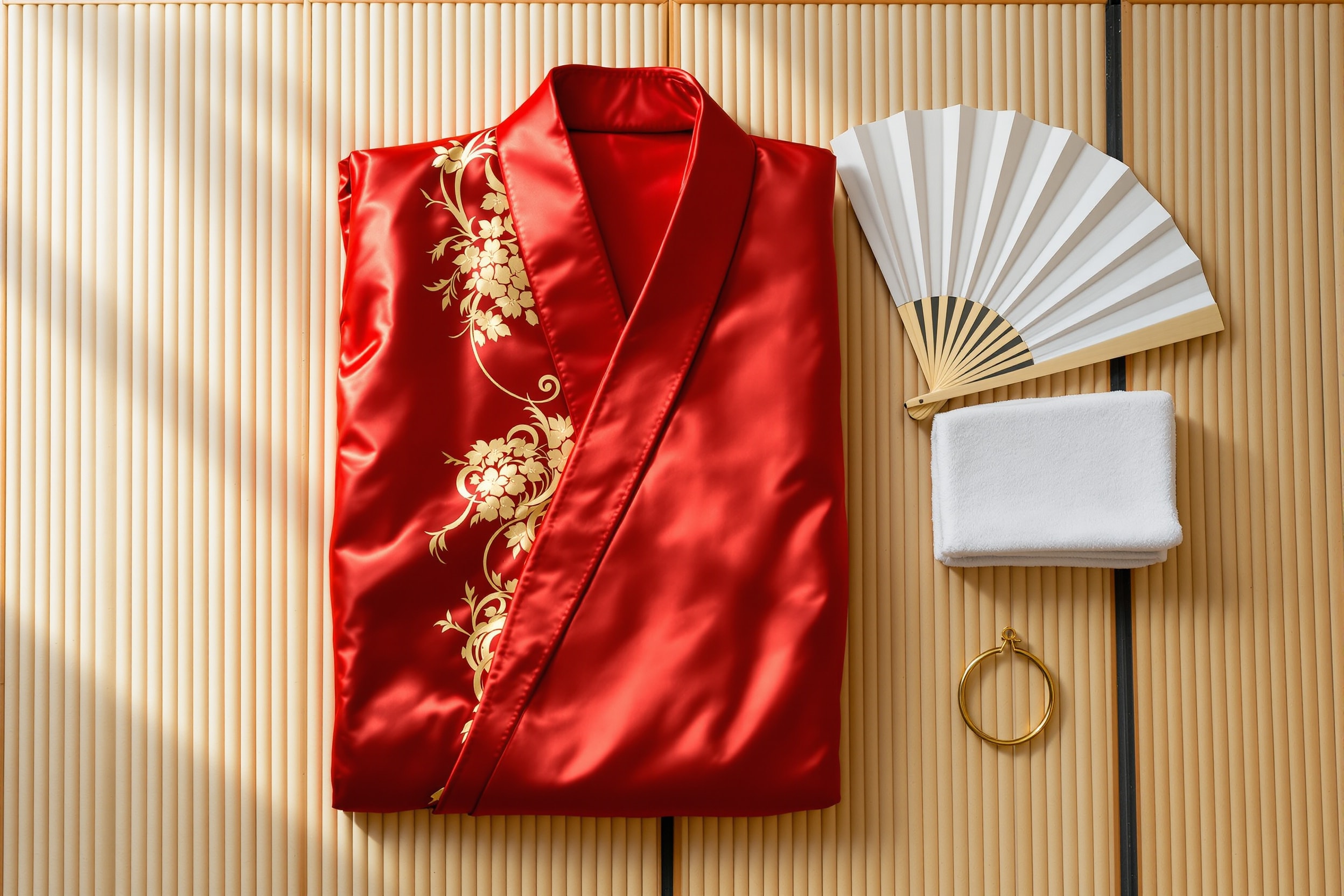
A rakugo storyteller wears a kimono and carries two small props onto the stage. That is the whole wardrobe and the whole prop department. This radical economy is not poverty of means but a deliberate aesthetic — and mastering these few elements is a lifetime's stagecraft.
The kimono as neutral canvas
The performer's kimono is chosen to be dignified but unshowy. Unlike the elaborate costumes of kabuki, it must not tie the storyteller to a single character, because he will play many. A relatively plain kimono lets the audience's imagination dress each character freely — the same body becomes a lord, a fishwife, a child and a ghost within minutes.
Kneeling in seiza for the length of a story, the performer must also wear and move in the kimono with complete ease. The garment's stillness is part of the art: a calm centre from which the voice and hands do all the work.
The sensu: a fan that is everything
The sensu, a folding fan, is the storyteller's most versatile tool. Closed, it can be chopsticks, a pen, a pipe, a knife, an oar or a fishing rod. Half-opened, it becomes a letter or a tray; fully opened, an umbrella or a fan in the literal sense. The performer signals each transformation through how the fan is held and moved, and the audience instantly reads the intended object.
Learning the "vocabulary" of the fan — the precise gesture that reads as slurping noodles versus lifting a sake cup — is one of the first crafts a student of rakugo acquires.
The tenugui: cloth of a thousand uses
The tenugui, a simple rectangle of cotton, is the fan's partner. Folded and mimed, it becomes a wallet, a book, a letter, a towel, a purse or a package. Where the fan supplies rigid objects, the cloth supplies soft and flat ones.
Together the two props cover almost anything a story might require. The constraint is liberating: because the objects are suggested rather than shown, a single tale can range across a marketplace of goods without a single real prop being carried on.
Rehearsing an invisible object
A prop transformation works only when its weight, size and resistance stay consistent. If the closed fan is a writing brush, the hand must remember where the imagined paper lies; if it becomes chopsticks, both the reach and the mouthful need a steady scale. Small inconsistencies can make the object disappear from the audience's imagination.
This is why prop practice is also observation practice. Handling a real cup, letter or pipe reveals the pauses and finger positions that make the mimed version legible. Once those details are absorbed, the fan and cloth can suggest the object without copying every movement mechanically.
The stage furniture
The storyteller performs from a raised platform called the kōza, seated on a cushion (zabuton). In the Kamigata (Osaka–Kyoto) tradition, a small lacquered table called a kendai may sit in front of the performer, sometimes tapped for rhythm. A name-placard (mekuri) at the side of the stage announces who is performing.
Every element is minimal and purposeful. Nothing on the rakugo stage exists to impress on its own; each object is a tool in service of the story, and the whole apparatus can be packed into a modest bag. This is stagecraft as discipline — the art of doing the most with the least.
The discipline of stillness
Perhaps the subtlest stagecraft of all is what the performer does not do. Kneeling in seiza for the length of a story, moving only from the waist up, the storyteller turns physical restraint into expressive power. Every gesture counts precisely because there are so few of them; a raised eyebrow or a tilt of the head carries weight that would be lost amid constant motion.
This economy of movement mirrors the economy of props. Together they teach the same lesson that runs through so much of Japanese aesthetics: that limitation, willingly embraced, can be the very source of expressive freedom.
Further reading
For the history of the kimono, see The Metropolitan Museum of Art, and general cultural notes at Web Japan.