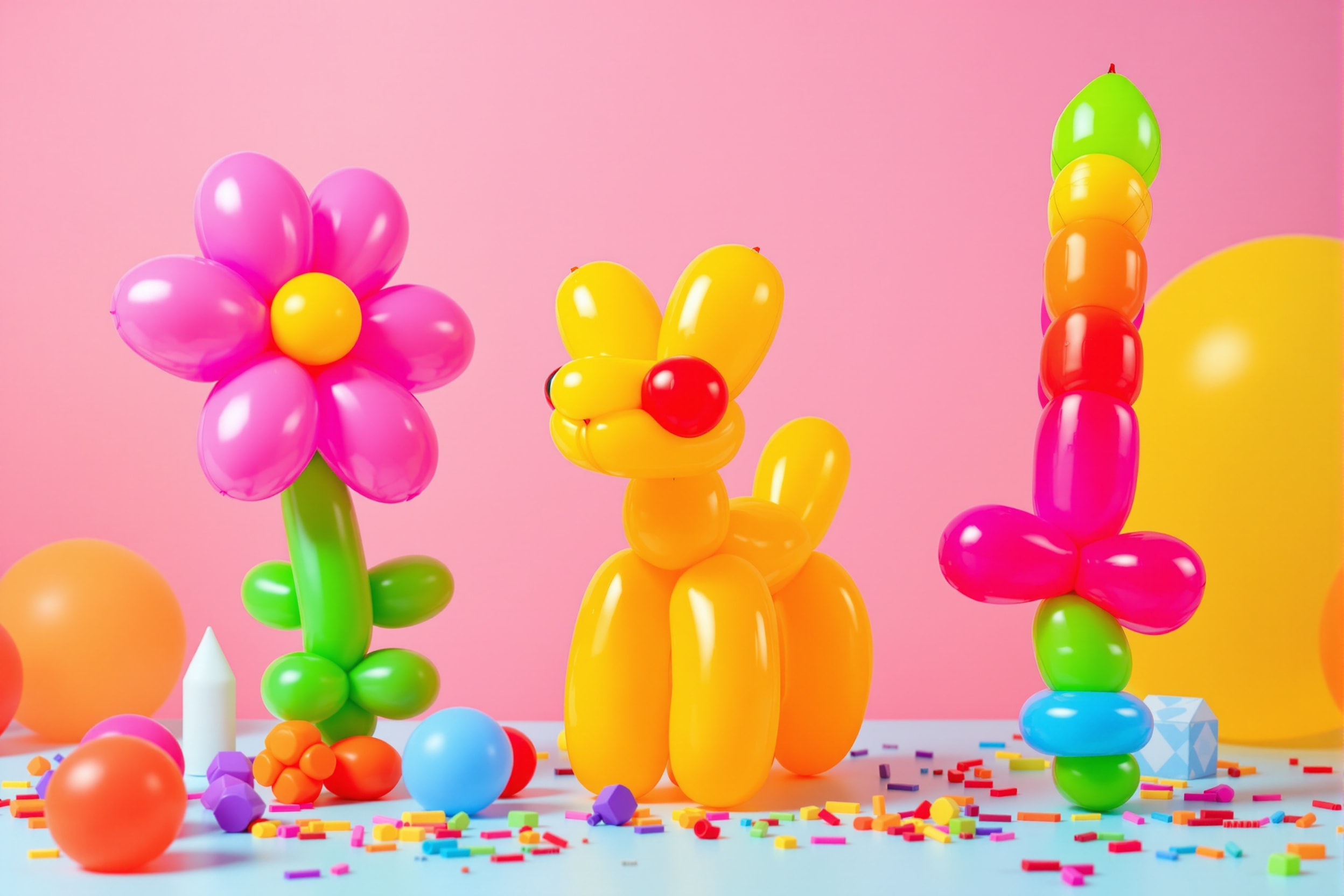
Alongside storytelling, balloon art — the craft of twisting long modelling balloons into shapes, characters and sculptures — is a staple of family stage performance around the world. Fast, colourful and unfailingly delightful, it is an art of the moment: a sculpture appears in seconds and belongs to whoever it is given.
Though it looks like child's play, balloon performance is a real discipline with its own history, techniques and showmanship.
From novelty to performing craft
Modern balloon modelling grew out of the mid-twentieth century, when durable pencil-shaped latex "twisting" balloons became widely available. What began as a fairground novelty developed into a recognised branch of variety entertainment, with professional twisters, conventions and a steadily expanding vocabulary of designs.
Today the craft ranges from quick line-work — the classic balloon dog made in a few practised twists — to enormous sculptural builds using hundreds of balloons. On stage, though, speed and clarity usually matter more than scale: the delight is in watching a shape emerge in real time.
The fundamentals of twisting
The core technique is the twist — pinching and rotating a section of an inflated balloon to create a bubble that holds its shape. From a handful of basic moves, an entire menagerie can be built:
- The basic twist, dividing a balloon into segments;
- the lock twist, which joins bubbles so they stay put;
- the ear twist (or pinch twist), for small details like ears, noses and feet;
- and the tulip twist, tucking the knotted end inside to form a rounded shape.
A performer learns to leave the right length of uninflated tail so the balloon has room to bend without bursting — a small piece of physics that separates a clean model from a loud pop and a startled child.
Performance, not just product
What lifts balloon modelling from a craft to a performing art is the presentation. A skilled balloon entertainer keeps up a running patter, involves the audience, plays with suspense ("what could this be?") and turns the inevitable occasional burst into a laugh rather than a disaster. The finished balloon is only half the show; the making of it is the other half.
This makes balloon art a natural companion to storytelling and comedy on the family stage. Both arts share the same virtues: portability, immediacy and a direct, warm relationship with the audience.
Colour, character and the young audience
Part of balloon art's magic is its instant legibility. A child does not need to be told that a wobbly yellow shape is a giraffe or that a red twist is a rose — the recognition is immediate and joyful. Colour does much of the storytelling, and the best performers choose their palette as deliberately as any painter, matching a balloon's hue to the creature or object taking shape.
This makes the craft especially powerful with young audiences, who experience the twisting as a small act of live magic. A balloon made and handed over becomes a keepsake of the show — a rare piece of theatre the audience gets to take home.
A craft anyone can begin
Balloon modelling is unusually welcoming to beginners. A pump, a bag of quality modelling balloons and a single afternoon are enough to master the balloon dog — the gateway model from which almost everything else follows. From there, hobbyists and aspiring performers build a repertoire one design at a time.
As with rakugo, the tools are humble and the art lives in the practitioner's skill and charm rather than in expensive equipment. It is entertainment reduced to its friendliest essentials.
Further reading
For technique references, see an introduction to balloon modelling. On the wider history of popular entertainment, see the Smithsonian Institution.